Gallery 1 Images

Site Information
About This Site
Historical Significance The Farewell Pilgrimage and the Final Sermon
Historical Significance
Historical Significance
The Farewell Pilgrimage and the Final Sermon In 10 AH (632 CE), our beloved Prophet Muhammad ﷺ performed his only complete Hajj, known as the “Farewell Pilgrimage” (Hajjat al-Wada’). On the 9th of Dhul Hijjah, he stood at Arafat and delivered a sermon that would become a moral and legal cornerstone for Muslims for all time. Key elements of the sermon, as recorded in authentic Hadith collections, include:
- The sanctity of life, property, and honour.
- The prohibition of usury (riba) and blood feuds from the pre-Islamic era.
- The rights of women and the importance of just treatment.
- The declaration that all believers are equal, with no superiority except through taqwa
(God-consciousness).
- The reminder that he was leaving behind the Qur’an and his Sunnah as guidance.
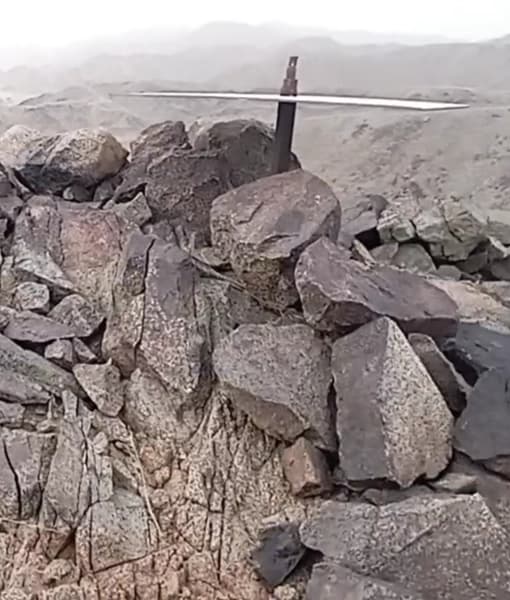
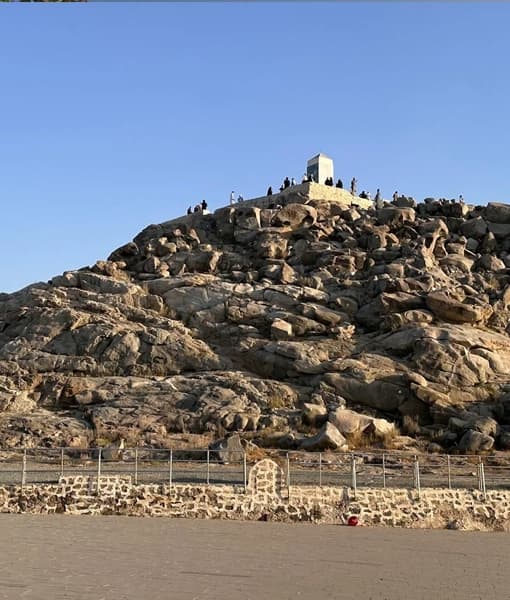
The Prophet ﷺ asked the gathered Companions (RA) whether he had conveyed the message, and they responded, “Yes, by Allah.” He then raised his finger towards the sky and said, “O Allah, bear witness,” repeating it three times. This moment, on the plains beneath Jabal al- Rahmah, sealed the completion of the religion. Arafat as the Heart of Hajj The importance of Arafat, and by extension Jabal al-Rahmah, is captured in the well-known statement of the Noble Prophet ﷺHajj is Arafat.” This means that the essential rite of Hajj is standing (wuquf) in Arafat on the 9th of Dhul Hijjah. Without it, the pilgrimage is incomplete. While pilgrims do not have to stand on the hill itself, being anywhere within the boundaries of Arafat suffices. Yet, the hill remains a focal point, a visual and spiritual anchor for the masses gathered on the plain. Connection with Prophet Adam (AS) and Early Human History Islamic tradition holds that Arafat is linked to the earliest human story. Many classical scholars and historians report that it was on this plain that Prophet Adam (AS) and Hawwa (AS) met after being sent down from Paradise. The name “Arafat” is sometimes connected with the Arabic word “araf” (to know), suggesting a place of recognition and reunion. While these accounts are based on traditional narratives rather than explicit Qur’anic verses, they have been widely cited in Islamic historical works and contribute to the layered significance of the site. The Name and Physical Description “Jabal al-Rahmah” literally means “Mountain of Mercy”. The hill is relatively small, rising about 70 metres above the surrounding plain, with a total elevation of roughly 340 to 372 metres above sea level. It is made of granite and stands out against the flat expanse of Arafat. Over time, it has also been called “Jabal al-Dua” (Mount of Supplication), reflecting its association with prayer and repentance on the Day of Arafah. A Hill That Holds a Sermon for All Time What makes Jabal al-Rahmah extraordinary is not its size, but what happened there. On this modest rise, the Noble Prophet ﷺ delivered a message that addressed the core of human dignity, justice, and faith. His words were not meant for a single audience; they were for every Muslim who would come after. When pilgrims look towards this hill on the Day of Arafah, they are not merely observing a geographical feature. They are standing in the shadow of a moment when the final structure of Islam was publicly affirmed, when the rights of the weak were proclaimed, and when the unity of the Ummah was declared before Allah. The Site Today Today, Jabal al-Rahmah is marked by a tall white pillar erected on its summit. This pillar indicates the traditional spot where the Prophet Muhammad ﷺ is believed to have stood during his sermon. The hill itself remains a natural granite formation, with no ancient structures preserved on it. Important points for visitors and pilgrims:
- What remains: The hill and the white pillar marking the traditional location.
- What has changed: The surrounding plain has seen extensive development for Hajj infrastructure, including roads, shelters, and services.
- Access: During Hajj, the area is part of the official Hajj route and filled with pilgrims.
Outside Hajj, access to Arafat may be restricted by Saudi authorities for security and organisational reasons.
- Religious practice: There is no special prayer or ritual unique to the hill itself; the essential act is standing anywhere in Arafat on the 9th of Dhul Hijjah.
Visitors should understand that while the hill is historically significant, the religious focus in Hajj is the plain of Arafat as a whole, not climbing or touching the hill. Why Pilgrims Still Visit Jabal al-Rahmah remains deeply meaningful because it is inseparable from the story of the Farewell Pilgrimage and the completion of Islam. For those performing Hajj, the sight of the hill evokes:
- The memory of the Prophet’s ﷺ final address to the Ummah.
- The weight of his words on justice, mercy, and human rights.
- The humility of standing before Allah on the Day of Arafah.
- The connection with generations of Muslims who have stood on this same plain.
Even for those reflecting from afar, Jabal al-Rahmah serves as a symbol of repentance, divine mercy, and the unity of believers across time and space. Frequently Asked Questions What is the significance of Jabal al-Rahmah in Islam? Jabal al-Rahmah is the hill in Arafat where our beloved Prophet Muhammad ﷺ delivered his Farewell Sermon during his only Hajj, making it a central landmark of the Day of Arafah and the Hajj pilgrimage. Is standing on Jabal al-Rahmah required for Hajj? No, it is not required to stand on the hill itself; the essential rite is to be anywhere within the boundaries of Arafat on the 9th of Dhul Hijjah, as the Prophet ﷺ said, “Hajj is Arafat.” Can visitors go to Jabal al-Rahmah outside the Hajj season? Access to the Arafat area, including Jabal al-Rahmah, is generally controlled by Saudi authorities and is primarily intended for pilgrims during Hajj; outside the season, visits may be restricted or not permitted.